The Origin
Divine Bowls is new. The craft behind it is not.
We've been making these bowls since 1975. We just didn't know they were singing bowls yet.
For decades, our focus was high-purity fused quartz products for industries where contamination isn't an inconvenience, it's a failure. Semiconductor. Solar. Applications where the vessel holding molten silicon must survive extreme temperatures while introducing zero impurities—where even trace contamination at parts per million can compromise performance.
If you've ever used a computer, a smartphone, or anything powered by a semiconductor chip, the silicon inside likely began its life in a vessel like the ones we make. If your home runs on solar panels, the polycrystalline ingots inside them were likely grown in quartz crucibles—containers prized for chemical inertness, resistance to thermal shock, and extraordinary purity. Quartz is the gold standard for these applications, and we've spent five decades refining how to form it.
That's the foundation. Fifty years of working at the molecular level, learning how quartz behaves under heat, developing proprietary molding processes that produce vessels of extraordinary purity and structural integrity.
And then—sound.
People discovered that these vessels—formed with such care for an entirely different purpose—produced extraordinary sound. They started seeking us out. Not for semiconductor manufacturing, but for the resonance.
We didn't pivot into the singing bowl market. The singing bowl market found us. And we realized the same precision that makes a crucible worthy of growing silicon crystals also makes an instrument capable of something profound.
Divine Bowls is how that expertise now reaches you directly—factory direct from the original makers, for the first time.
Seamless Construction
The Seamless Difference
An egg is nature's perfect vessel—seamless, one-piece construction designed for purity and protection. Our bowls follow the same principle.
Each instrument is formed using a proprietary molding process refined over five decades. No welding. No bonding. No fabrication from separate pieces. No grinding down to reach a target note. No surface coatings applied after the fact. The bowl emerges whole—a single, uninterrupted structure created at over 3,000°F.
Why does this matter?
When quartz is welded, the fusion process can embed impurities into the material. When it's ground or lathed after formation, the surface becomes porous and stressed. When pieces are bonded together, you create joints—and joints are weak points. Each of these compromises affects both the integrity of the vessel and the quality of its sound.
Our molding process eliminates all of it. The result is a uniform structure throughout—no internal stress, no contamination points, no hidden fragility. Vibration flows freely through the material, producing the organic, living quality people describe when they play our bowls. That clarity isn't added later. It's built in from the moment of formation.
The only perfect weld is no weld at all.
Why We're Still Here
When much of the American quartz manufacturing industry moved overseas in the 1980s and 90s—chasing lower production costs—we stayed. Not out of obligation, but because we understood what we'd lose if we left: five decades of process refinement, direct quality control at every stage, and the institutional knowledge that lives in our facility and our people.
Some things can't be outsourced. Purity at 99.998% requires controlling every variable. Seamless construction requires equipment and expertise that took generations to develop. We're still in Ohio because that's where the craft lives.
Born Complete
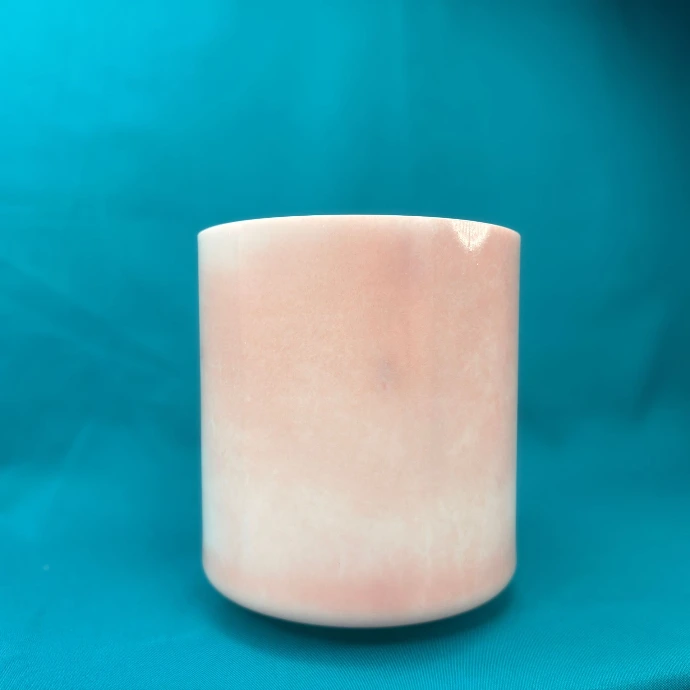
Each bowl emerges from the furnace in its final shape and size—with any mineral, herb, gemstone or element already fused within. No additional shaping. No lathing. No surface glaze or coating applied after the fact. The color you see isn't painted on or applied afterward—it emerges during formation, enhanced by natural elements integrated throughout the quartz in the same process that creates the infusion. Color, essence, and structure: formed as one. The bowl is whole from the moment it's created.
The only refinement: a precision cut using diamond blades to establish the exact height. This subtle step is what determines the fundamental note the bowl will sing. The geometry of the vessel—its diameter, wall thickness, and height—creates the frequency. We're not tuning after the fact. We're revealing what was already there.
The Infusion Process
This is where our process allows something no other method can achieve: true infusion.
When elements are heated during formation—at over 3,000°F—they don't sit on the surface. They are integrated into the quartz at the molecular level, becoming part of the structure itself. Even elements that transform or evaporate at extreme temperatures leave their imprint: a unique microstructure within the amorphous quartz. That microstructure is what vibrates. That's what you hear and feel resonating in the space around you.
We've been refining this infusion technology for over fifty years. Herbs, minerals, gemstones, precious metals, tree resins, teas—each creates distinct resonance patterns based on how it interacts with the quartz during formation.
Infused with Purpose
Every Divine Bowls instrument is made with intention. Since our founding, we've continued refining the infusion process—learning how to incorporate as much of each element as possible without compromising the bowl's stability. There's a threshold: add too much, and the vessel becomes fragile. Finding that balance is part of the craft.
For custom orders, we take it further. We can set your specific intentions, play meaningful music during formation, or incorporate personal elements while the bowl is being born. The vessel doesn't just carry an infusion—it carries purpose from its first moment of existence.
Purity & Traceability
You've likely heard a wine glass sing when you run a wet finger around the rim. You may have also noticed it sounds thin—almost a whine rather than a tone. That's because most glass contains metal flux, added so it melts at lower temperatures and can be shaped more easily. The tradeoff is resonance. The material can vibrate, but it can't sustain. It can't sing.
Purity determines tone. The cleaner the quartz, the clearer the sound—and the longer it holds. Bowls made from lower-grade materials, or from glass masquerading as crystal, produce a fundamentally different quality of resonance. Some can't sustain a tone for more than a few seconds. Ours sing for minutes from a single strike.
Grade A: 99.998% Pure
Our quartz is sourced from a worldwide leader with rare access to one of the most pure quartz deposits in the United States. We test all raw materials in our on-site laboratory before they enter production. This isn't a marketing designation—Grade A reflects a specific, verifiable purity standard that we maintain across every bowl we make.
Each instrument receives a unique identification number, tracked internally and provided to you. We know what we made, when we made it, and what went into it.
The Balance
When it comes to infused bowls, purity doesn't mean absence—it means intentional inclusion. Natural crystals form with trace elements embedded within them, and those inclusions are what give each stone its unique properties. The same principle applies here: adding elements to quartz creates distinct resonance patterns that wouldn't exist in pure quartz alone.
But there's a threshold. Add too much of an element and the bowl becomes unstable. Add too little and the resonance pattern doesn't fully emerge. Finding that point—where the element expresses completely without compromising the vessel—is something we've learned over decades.
It's art and science, held in balance. That's the craft.
Wabi-Sabi Philosophy
Our Wabi-Sabi bowls are a celebration of beauty found in imperfection. Just as no two raw gemstones are ever exactly the same, each bowl carries its own natural variations, markings, and unique character. Formed through fire, sound, and transformation, every bowl becomes a one-of-a-kind expression of resonance and individuality.
Occasionally, a bowl may reveal subtle irregularities or character marks that some might view as imperfections. To us, these are part of the bowl’s story—signs of authenticity that often deepen its warmth, richness, and voice. In the spirit of the Japanese philosophy of Wabi-Sabi, we honor these natural variations as reminders that true beauty lives not in flawlessness, but in presence, uniqueness, and soul.
By embracing these beautifully imperfect bowls, we are able to offer fully playable instruments at a significant cost savings while preserving the artistry, resonance, and spirit that make each bowl truly special.
Perfectly playable. Beautifully unique
A Lifetime of Resonance
We still make these bowls by hand in Ohio—not because we have to, but because the feedback from our community reminds us why we started. People write to tell us about the bowl that became part of meaningful personal rituals, the one that calls the kids before dinner, the one their daughter plays during quiet moments. These instruments become part of people's lives.
Some things are worth keeping for a lifetime—and passing on.
These bowls resonate for generations. They become time capsules for whatever you breathe into them: your intentions, your routines, your story. The sound you play today can be the same sound your grandchildren hear.
We'd love for one of these instruments to find its way into your home.